School of Ancient Geomantic Education (SAGE)
Prophetic Wisdom of the Dots
A consequential decision may already have been subjected to data analysis, modelling, expert opinion, feasibility studies and scenario planning — and yet the decision-maker may remain uncertain. At that point, the problem is no longer simply lack of information. SAGE offers a different form of consultation — rooted in ancient geomantic traditions and brought into contemporary practice.

You have the data. The models have been built. The scenarios have been stress-tested. The risks have been mapped. The sensitivity analysis has been run. The advisers have given their counsel.
And yet, the decision remains unresolved.
At the highest levels of corporate life, uncertainty does not necessarily disappear with more information. Sometimes it becomes more visible. The problem is no longer a lack of analysis. It is a confrontation with the limits of what analysis can reach.
Financial models inform. Experts advise. Evidence constrains. Due diligence narrows the field. But ultimately, someone must decide — and that decision often contains elements no model can completely quantify: conviction, timing, the character of people involved, and the possibility that circumstances contain dimensions beyond what we can presently measure.
What can be observed and measured
What can be modelled and projected
What experience and counsel can offer
What the decision-maker alone must weigh
A different order of knowing

Before modern decision sciences separated empirical analysis from divination, rulers, courts and decision-makers confronted uncertainty without the analytical machinery available today. In that world, consultation of the unseen could coexist with observation, experience, counsel and political judgement.
Geomancy belongs to this older intellectual and divinatory tradition — a systematic means of seeking correspondence with an order believed to transcend ordinary human knowledge. It was transmitted, adapted and preserved across India, Persia, the Islamic world and Renaissance Europe.
The purpose of this history is not to claim that ancient practice validates modern use. It is to acknowledge that the impulse to consult beyond the visible is as old as consequential decision-making itself.
Historical context is presented for intellectual background, not as scientific proof of efficacy.
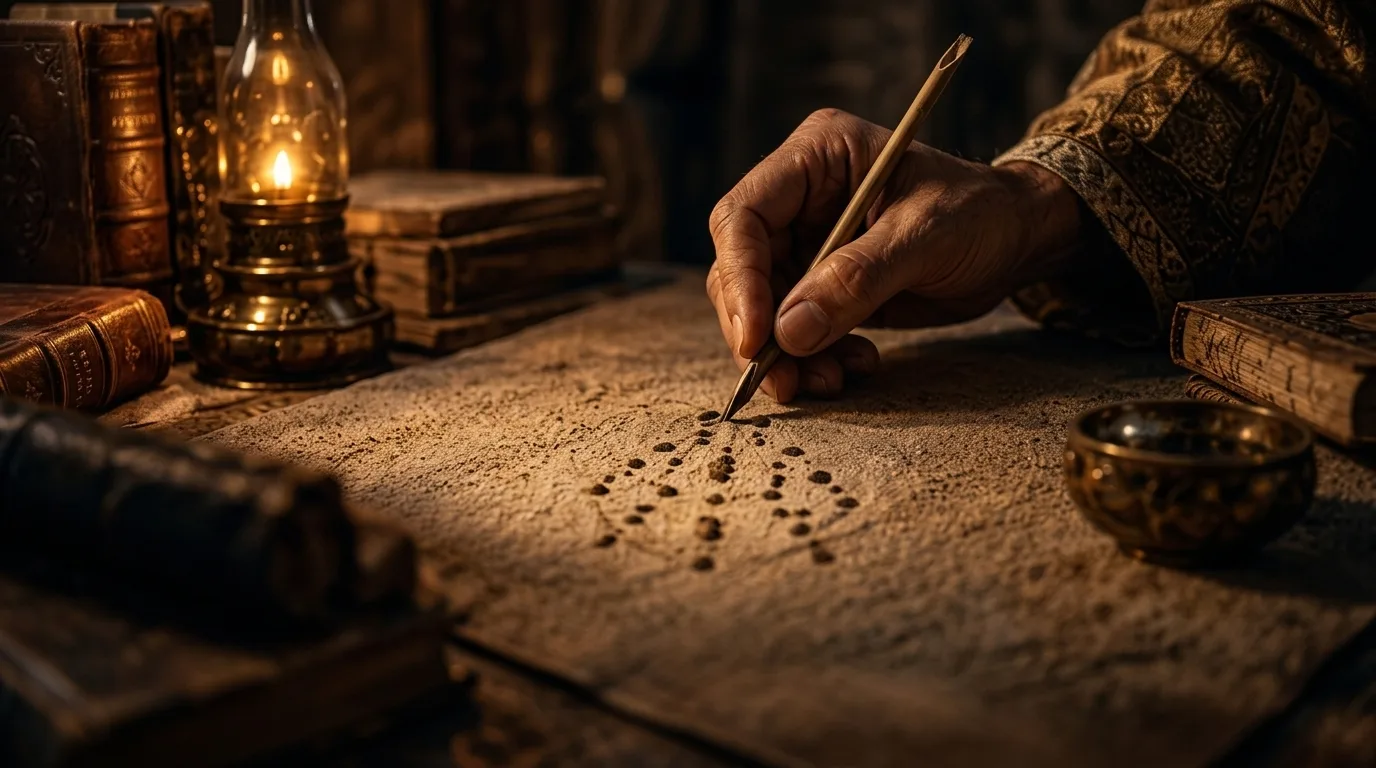
Geomancy begins with an apparently random act. Dots are generated — by hand, by computation, or by tradition-specific method. Patterns emerge. The resulting figures are interpreted through an established symbolic system that has been refined across centuries.
The mystery is not concealed. It is the central proposition.

We deliberate. We calculate. We choose. Human agency is the foundation of every decision.
Yet we do not create all the circumstances within which our choices unfold. Events intervene. Other people act. Markets shift. Timing changes. Opportunities appear that no model predicted. Obstacles emerge that no risk assessment foresaw.
Different traditions have given different names to the greater order within which this happens: Providence. Destiny. Divine Will. Cosmic order. The unseen. The common thread is the ancient recognition that human agency, however real, operates within something larger than itself.
Geomancy can therefore be understood as a means of seeking correspondence with that greater order — not to control it, but to listen for its indications.
"You don't abandon the model when you consult the oracle.
You consult the oracle precisely because you have already exhausted the model."
These tools answer questions within their respective domains.
The oracle addresses a different question entirely.
When two strategic paths both appear viable — and the analysis cannot separate them.
When succession, loyalty or the character of those involved becomes difficult to read.
When the visible facts do not fully explain the adversity ahead — or the stability beneath.
When capital, partnership or commitment involves dimensions that numbers alone cannot capture.
When the question is not only what to do, but when — and whether this is the moment.
The decision-maker formulates the dilemma — the unresolved question that persists after analysis.
The geomantic figures are generated and computed according to the established rules of the selected tradition. The oracle is not invented by the system.
SAGE interprets and articulates the resulting figures for contemporary readers. The tradition determines the structure. The system gives it voice.
An important distinction: The oracle is not generated by the language model. The tradition determines the governing figures and rules. Modern computation applies those rules faithfully. SAGE's AI-assisted synthesis then interprets and articulates the resulting reading in clear, contemporary language.
The rules are traditional. The computation and articulation are modern. The figures belong to the tradition — Indian Ramal Shastra or Western Geomancy — not to the machine.
SAGE preserves the Indian geomantic tradition — Ramal Shastra — as a distinct computational and interpretive framework, with its own figures, its own rules of derivation, and its own system of meaning.
SAGE equally preserves the Western geomantic tradition as a separate system — rather than collapsing both into a generic oracle. Each tradition speaks in its own symbolic language.
SAGE does not claim scientific validation for geomancy. It does not promise certainty. It does not replace professional advice, evidence, due diligence, or any of the analytical instruments that responsible decision-making requires.
What it offers is something different: consultation from an ancient divinatory tradition, for those willing to engage with that tradition alongside — never instead of — their existing decision-making process.
For the spiritually inclined, that consultation may be understood as seeking alignment with Divine Will. For others, it may be approached as a reflective encounter with uncertainty from a perspective radically different from anything the corporate world ordinarily provides.
Either way, the invitation is the same: to ask one more question, from a place beyond the spreadsheet.
The reports have been read. The models have been tested. The advisers have spoken. The due diligence has been completed. And still, the decision remains yours to make.
Perhaps the question is no longer: "What more can I calculate?"
Perhaps it is: "What am I not seeing?"
When analysis reaches its limits, consult the oracle.