
1. The Paradox of Modern Decision-Making
A leadership team gathers in the boardroom.
They are considering a major restructuring, a new market, an acquisition, a leadership transition, or a significant reallocation of capital.
The stakes are high. The decision may affect thousands of employees, millions in capital, and the organization's direction for years.
They have enormous amounts of information.
Financial projections cover multiple scenarios. Market intelligence tracks competitors and customers. Risk registers identify known exposures. Dashboards display key performance indicators in real time. AI can now synthesize thousands of pages of information in seconds.
And yet, at some point, the room often reaches an uncomfortable silence.
Someone eventually asks the question everyone is thinking:
"We know what the numbers say. But what are we still missing?"
This is the paradox of modern decision-making.
We have built extraordinary systems for gathering and processing information. Yet, when decisions become consequential, uncertainty does not disappear.
A decision can be supported by excellent data and still contain unresolved questions about readiness, alignment, resistance, timing, resources, or consequences that are difficult to model in advance.
The question is not whether the existing tools are useful.
They are.
The question is whether there may be another layer of analysis worth considering.
Modern management begins with what can be observed, measured, modeled, and compared.
Ancient intelligence began from a larger question:
What if the visible world is only one layer of an ordered reality?
What if the forces that govern the movements of nature are not entirely separate from the patterns unfolding in human affairs?
This is the philosophical ground from which systems such as Ramal emerged.
2. More Information Does Not Eliminate Uncertainty
Modern organizations have developed a sophisticated decision stack.
- Financial models project revenue, costs, capital requirements, and scenarios.
- Market intelligence examines competitors, customer behavior, positioning, and trends.
- Scenario planning explores different possible future conditions.
- Risk registers identify known operational and strategic exposures.
- Business intelligence dashboards make organizational performance visible in real time.
- Generative AI can synthesize enormous quantities of information and produce increasingly sophisticated analysis.
Each of these tools answers important questions.
But they do not necessarily answer this one:
What is the structural condition surrounding this specific decision right now?
That is a different kind of question.
Conventional tools are generally strongest when working with measurable, historical, financial, operational, or externally observable information. They are not designed to produce a symbolic interpretation of the decision moment itself.
That does not mean they fail.
It means they examine different dimensions of reality.
And that distinction matters.
Information is not the same as decision clarity.
3. The Missing Layer
Conventional decision systems describe the visible and measurable layers of a situation.
Financial models can show what may happen under certain assumptions. Operational systems can show what is happening now. Market research can show how the external environment is changing.
Ancient intelligence begins from the possibility that there is a deeper order beneath those visible manifestations.
The question is not whether the measurable world is real.
It is.
The question is whether it is the whole of reality relevant to human decision.
SAGE explores the possibility that the condition of a decision can also be read through its relationship to a larger order.
The objective is not to construct another predictive model based on more historical data.
It is to examine the structural pattern surrounding a particular decision and surface considerations that may not be obvious from conventional analysis alone.
That is the idea behind the SAGE Corporate Stability Audit.
4. The Unexpected Source: Ramal
Ramal is an ancient expression of a much older intelligence.
It emerged from a worldview in which the universe was ordered and correspondences between levels of reality were meaningful. Indian Ramal, a form of geomantic inquiry, developed a structured symbolic language for reading the condition of the moment in relation to the question being asked.
The figures, houses, testimony, movement, and Court are not isolated tricks for prediction. They belong to a language for reading the condition of the moment.
Ramal contains a structured symbolic framework involving:
- Figures representing elemental and directional states;
- Houses representing different domains of the inquiry;
- Relationships between figures and houses — symbolic correspondence;
- Testimony describing how different parts of the structure support or challenge one another;
- Judicial resolution through the Court — a movement from testimony toward resolution within the symbolic order;
- Directional movement through concepts such as Gati;
- Contextual interpretation of the resulting structure in relation to a specific question.
This is not an unstructured mystical narrative. It is a formal symbolic intelligence — a structured divination rooted in cosmic correspondence, elemental manifestation, and judicial order.
That is what SAGE has chosen to digitize.
5. The Worldview Behind the System: An Ordered Cosmos
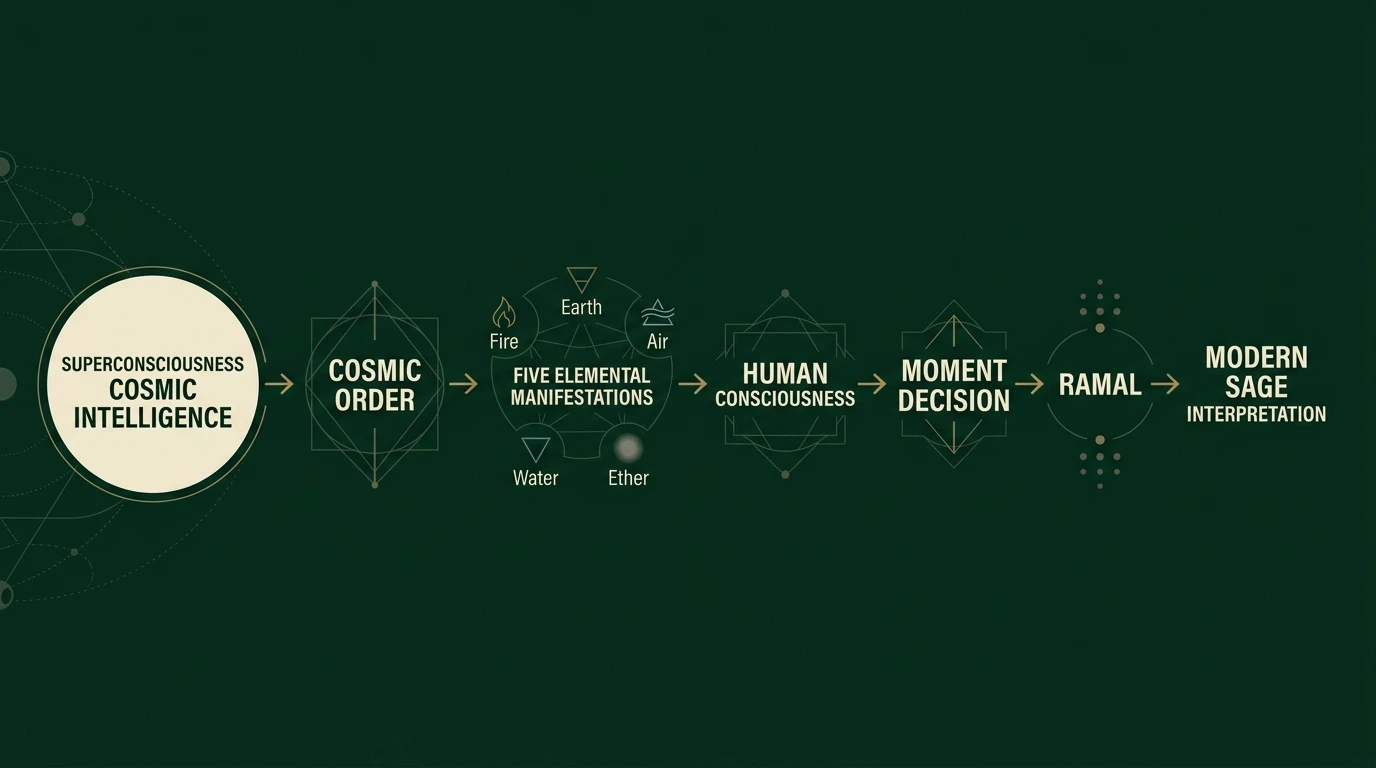
The universe is not viewed by SAGE as an arbitrary collection of disconnected events. It is approached as an ordered whole in which consciousness, nature, human action, and the larger cosmos participate in patterns of relationship and correspondence.
Within this worldview, the cosmos expresses intelligence and order. Human consciousness participates in that larger order. Natural manifestations reflect it. And moments of inquiry can be approached as meaningful states rather than meaningless randomness.
The question was therefore not always whether a symbolic pattern caused an event. It could instead be whether the pattern corresponded to the condition of a particular moment — and therefore offered another way of interpreting it.
Ancient intelligence is not ancient because it is old. It is ancient because it belongs to a civilization of thought that approached reality as an interconnected order.
Its concern was not merely prediction. It was correspondence. Not isolated events, but relationships between levels of existence. Not superstition, but interpretation within a cosmological grammar.
This is the philosophical foundation from which Ramal — and SAGE — proceed. It is a metaphysical position, not an empirical claim.
6. The Intelligence of the Five Elements
In the SAGE worldview, the visible world is articulated through fundamental modes of manifestation traditionally expressed as the five elements:
Agni — Fire
Transformation · Intensity · Activation
Prithvi — Earth
Structure · Stability · Materialization
Vayu — Air
Movement · Exchange · Communication
Jal — Water
Cohesion · Adaptation · Continuity
Akasha — Ether
Space · Connection · Possibility · Field
These are not the elements of modern chemistry. They are principles of manifestation and relationship — ways in which the traditional worldview describes how different qualities of reality become perceptible.
Within the SAGE philosophical framework, these elemental principles are not separate from consciousness. They are ways in which a larger intelligence is understood to become perceptible in manifested reality.
From Superconsciousness to Manifestation
SAGE uses the term superconsciousness to describe the deeper intelligence or unifying field that, within this worldview, stands behind the apparent multiplicity of existence.
The purpose of the concept is not to introduce a supernatural character controlling individual events like a puppeteer. It points instead to the possibility that consciousness and existence participate in an underlying order greater than individual human awareness.
In this view, the five elements are not merely physical substances. They are symbolic languages through which different qualities of manifestation become intelligible.
Human decisions are therefore not presented as isolated mechanical events. They occur within nature, within consciousness, and within a larger order. That is the philosophical proposition that makes Ramal intelligible.
7. When Uncertainty Was a Matter of State
Historically, consequential decision-makers did not always separate governance, cosmology, timing, ritual, and specialist forms of knowledge in the way modern institutions tend to separate strategy, finance, law, and operations.
Historical sources document geomancy and related divinatory disciplines within learned, manuscript, elite, and courtly knowledge cultures. The Arabic and Islamic tradition of ʿilm al-raml, or geomancy, developed a formal 16-position structure, while Ottoman scholarship preserved and discussed geomantic practices within broader bodies of occult and cosmological knowledge.
Such evidence establishes historical significance: these were recognizable intellectual and advisory practices within particular historical cultures.
Historical Context — Selected Sources
- National Library of Medicine — Astrology, Divination, and Magic
- National Library of Medicine — Islamic Medical Manuscripts
- Oxford Academic — Ottoman Occult and Divinatory Knowledge
- Oxford Academic — Geomancy and the Ottoman Occult Sciences
- Oxford Academic — Geomancy as a Structured Transformation System
8. Are the Dots Random?
A skeptical executive may reasonably ask:
"But aren't these just randomly generated dots?"
The answer requires separating the generation of a state from the rules applied to that state.
The starting configuration may be contingent.
The interpretive grammar applied to that configuration is not.
CONTINGENT STARTING STATE
↓
FIXED SYMBOLIC GRAMMAR
↓
DETERMINISTIC PROCESSING
↓
STRUCTURED OUTPUT
Once the state is established, the system processes it according to a defined symbolic structure: figures, houses, relationships, testimony, Court, and other canonical rules.
SAGE's contribution is to make that processing deterministic and reproducible in software.
A chess position may arise from a sequence of contingent moves. Once the position exists, however, the rules governing its analysis are fixed.
The engineering claim and the philosophical claim are therefore different.
Level 1 — Technical
Once generated, the symbolic state is processed through fixed, deterministic rules. SAGE makes that processing reproducible, inspectable, and testable.
Level 2 — Philosophical
Within the Ramal worldview, the initial state is not assumed to be meaningless randomness. It is understood as a possible correspondence to the moment of inquiry — a reflection of the condition of that moment within a larger order.
The software establishes determinism of processing. The worldview gives meaning to correspondence.
SAGE's engineering makes the symbolic grammar reproducible. The meaning assigned to the moment rests on the underlying traditional worldview.
Correspondence Rather Than Causation
SAGE does not claim that the symbolic pattern causes the corporate outcome. The traditional proposition is one of correspondence: that the symbolic configuration reflects the condition of the moment.
SAGE's engineering objective is to make that correspondence inspectable:
Can the structure of the traditional system be digitized faithfully enough to make its analysis reproducible, inspectable, and testable?
The question is therefore not:
"Why should a modern executive believe in ancient divination?"
A more interesting question is:
"Can a structured symbolic framework rooted in cosmic correspondence be digitized rigorously enough to serve as a modern decision perspective?"
That is the experiment SAGE undertakes.
9. Why SAGE Digitized It
SAGE did not simply take an ancient text and ask a language model:
"What does Ramal say about this company?"
That would allow the language model to generate the underlying reasoning itself.
Instead, SAGE separates calculation from interpretation.
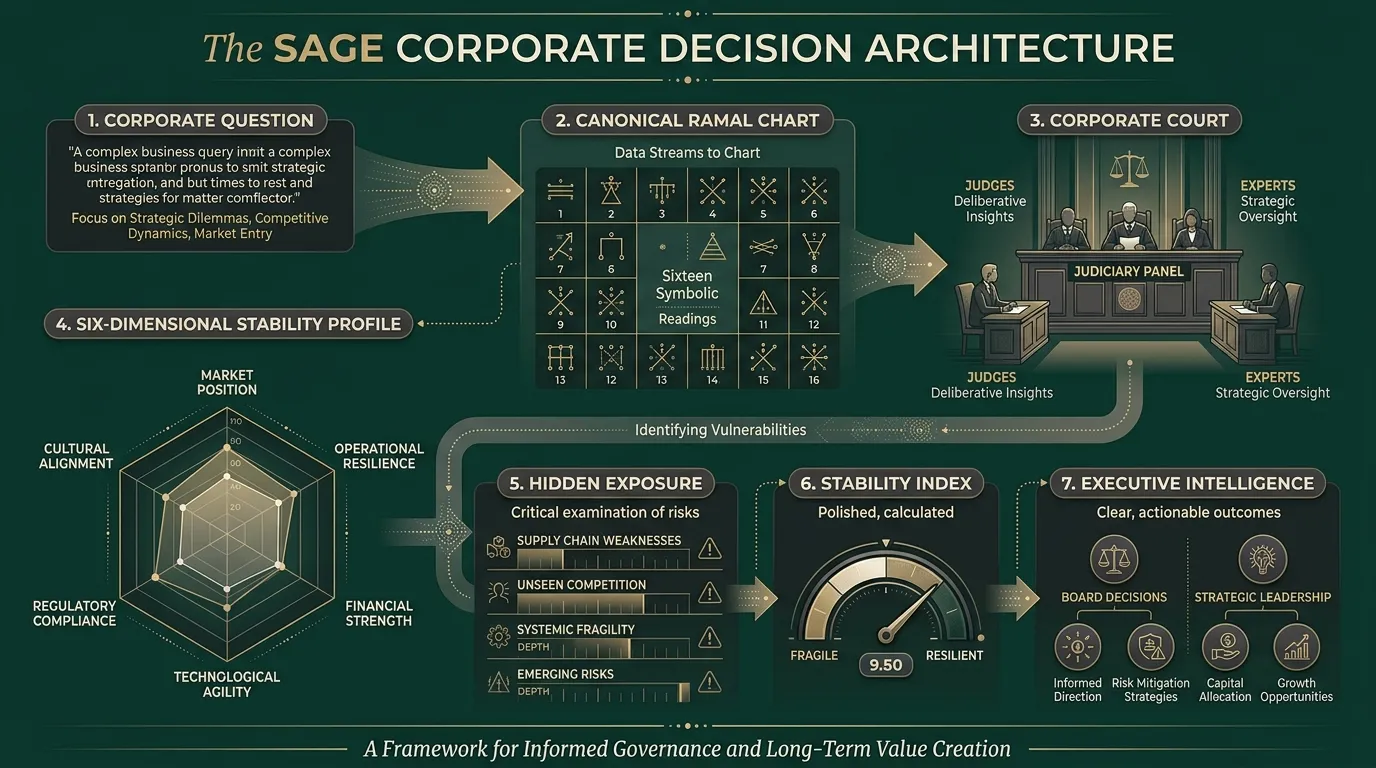
The process follows a deterministic sequence:
Inquiry
The decision-maker formulates a specific question.
↓
Figure Generation
The foundational symbolic data are generated according to the selected rules.
↓
Chart
A complete 16-house Ramal structure is constructed.
↓
Canonical Judicial Analysis
The system applies the relevant judicial and interpretive rules.
↓
Corporate Dimensions
The resulting structure is mapped into a six-dimensional Corporate Stability Profile.
↓
Stability Index
A SAGE-defined deterministic summary is calculated from the Court condition and Corporate Profile.
↓
AI Synthesis
The deterministic findings are translated into clear executive language.
This creates a crucial boundary:
The engine calculates. The AI interprets.
The AI does not decide the Court.
It does not independently calculate the Corporate Stability Profile.
It does not invent the Stability Index.
Its role is to explain the deterministic findings, explore their relationships, identify areas deserving attention, and synthesize the result into an executive report.
10. The Corporate Stability Audit
A corporation is itself a layered system. Individuals form teams. Teams form functions. Functions form the enterprise. The enterprise interacts with markets, society, resources, environment, and time.
A decision made at one level can propagate through every other level. This is precisely why the SAGE concept of correspondence becomes relevant to Corporate Stability.
The Corporate Stability Audit asks not merely what the organization is doing, but what pattern of forces is present around the decision it is contemplating.
This methodology forms the foundation of the Corporate Stability Audit.
The Audit is designed around one question:
What is the structural condition surrounding this organizational decision?
It does not attempt to reduce a complex corporate situation to a simplistic yes-or-no answer.
Instead, it creates a multidimensional Corporate Stability Profile.
The purpose is not to replace conventional business analysis. It is to provide another structured perspective on a consequential decision.
That profile examines six dimensions.
11. Six Dimensions of Corporate Stability
Organizational Foundation
This dimension examines the structural condition of the organization at its foundation.
The question is:
Is the organizational foundation supporting the contemplated change?
The analysis considers the foundational house and its relationship to the wider Court context.
A strong foundation does not guarantee successful execution.
A strained foundation does not automatically mean failure.
It indicates the structural condition from which the proposed change would have to operate.
This is complementary to conventional organizational diagnostics and management assessment.
Resources & Realization
Ramal contains structural indicators associated with material support and realization, including concepts such as Artha and Dhana Saham.
The Corporate Stability Audit uses these and related canonical signals to examine the structural ease or difficulty surrounding the acquisition, allocation, and realization of resources for the decision under consideration.
This is not financial accounting.
The system does not calculate revenue, profitability, cash balances, or liquidity.
Instead, it asks:
Does the structural pattern provide support for the realization of the resources required by the initiative?
Operational Resilience
A strategy is only useful if an organization can execute it.
Operational Resilience examines the structural condition surrounding continuity, execution, and operational support.
The analysis considers relevant houses, canonical support and challenge signals, and the concept of Mizan, or balance.
The purpose is not to perform a conventional operational audit.
It does not inspect individual processes or certify operational efficiency.
Instead, it explores whether the structural pattern surrounding the inquiry appears supportive, constrained, mixed, or strained from an execution perspective.
Leadership & Execution
Major decisions depend on authority and the ability to translate intention into action.
This dimension examines the structural relationship between leadership and execution in the context of the broader Court.
Relevant evidence can include: authority-related houses, Judge and Seal relationships, Verdict Path, Court coherence, relevant supporting and challenging signals.
The analysis does not attempt to diagnose individual personalities.
It does not claim that an executive is competent, incompetent, indecisive, or psychologically constrained.
It examines the structural condition surrounding authority and execution.
Growth & Realization
When the decision involves expansion, market entry, new products, or strategic development, Growth & Realization becomes particularly important.
The analysis considers growth-related houses and canonical indicators such as Anand Bhava and Dhana Saham, together with supporting and challenging evidence.
The objective is not to forecast revenue.
It is to examine whether the structural environment appears supportive of expansion and realization.
Hidden Exposure
For an executive, this may be one of the most interesting dimensions.
Hidden Exposure refers to latent structural conditions that may deserve closer examination.
It can incorporate: H8 and H12 conditions, relevant conflicts, canonical discord, supporting or challenging testimony.
The phrase "Hidden Exposure" does not mean that the system has discovered hidden fraud, concealed liabilities, misconduct, or criminal behavior.
A High Hidden Exposure classification is not an accusation.
A High Hidden Exposure reading is a signal for closer examination, not a factual claim about wrongdoing.
Its purpose is to identify areas where management may wish to apply additional attention or conventional due diligence.
12. The Corporate Court: Where the System Becomes Different
The six dimensions provide a multidimensional profile.
But the SAGE framework adds another layer that is central to the Ramal tradition: the Corporate Court.
The Court follows a structured progression:
Witness 1 → Witness 2 → Judge → Seal
The Witnesses provide testimony within the Court.
The Judge provides the judicial resolution, while the Seal represents the resulting structural condition or manifestation.
Together, they form the canonical judicial layer of the analysis — a movement from testimony through discernment toward judgment and manifestation within the symbolic order.
The Court is therefore not simply another score.
It establishes the overarching judicial condition in which the Corporate Stability Profile is interpreted.
This creates a deliberate hierarchy:
Court → Corporate Profile → Stability Index
The six dimensions do not simply vote equally to produce the final judgment.
A mixed resource picture has a different meaning when the Court is strongly supportive than when the Court itself is challenged.
That distinction is fundamental to the SAGE architecture.
13. Why the Stability Index Is Not a Probability
The Corporate Stability Audit provides a numerical summary called the Corporate Stability Index.
It is important to understand exactly what this number means.
The Stability Index is a SAGE-defined deterministic summary of the Corporate Stability Profile within the condition established by the Canonical Court.
The Court first establishes a numerical anchor range:
- YES → 65–100
- MIXED / OTHER → 40–75
- NO → 0–45
The strength of the multidimensional Corporate Profile then determines where the result falls within that Court-defined range, with Hidden Exposure incorporated through the defined SAGE methodology.
The resulting score receives a separate presentation band:
- 80–100 — Strong Structural Stability
- 65–79 — Moderate Structural Stability
- 50–64 — Conditional Structural Stability
- 0–49 — Structural Vulnerability
These are two different concepts.
The Court Anchor Range comes from the canonical judicial condition.
The Stability Band comes from the final numerical score.
Most importantly:
85/100 does not mean an 85% probability of success.
It is not a statistical probability, a forecast, or a financial performance estimate.
It is a deterministic summary of structural conditions within the Court's condition.
14. What Do You Actually Do With the Stability Index?
A Stability Index is useful only if it changes how a decision is examined.
The Index is therefore best understood as an executive decision-posture indicator, not as an instruction to proceed or stop.
The Court establishes the overarching condition (context). The Corporate Stability Profile identifies where support and constraint are concentrated (canonical evidence structure). The Index provides a compact summary of how strongly that profile sits within the Court's condition. The Index is an executive compression layer, not an additional source of evidence. Ultimately, the final report translates these structural findings into strategic meaning (interpretation).
This allows an executive team to ask four practical questions:
- Where should we focus attention?
- What should we investigate more deeply?
- What should we strengthen or protect before execution?
- What conventional analysis or due diligence should accompany this decision?
The practical value of the Index is not that it makes the decision for you. Its value is that it helps indicate where management attention, challenge, mitigation, and conventional diligence may deserve to be concentrated.
| Stability Band | What It Suggests | Appropriate Executive Posture |
|---|---|---|
| Strong Structural Stability (80–100) | The multidimensional profile is strongly supportive within the condition established by the Court. | Focus on execution, residual risks, and preserving the structural strengths identified by the analysis. |
| Moderate Structural Stability (65–79) | The overall structure is broadly supportive, but material constraints or areas of dependence deserve explicit attention. | Examine the identified constraints and supporting conditions before and during implementation. |
| Conditional Structural Stability (50–64) | The profile contains substantial tensions that may affect how the decision should be framed, sequenced, or supported. | Consider strengthening weak dimensions, staging implementation, adding safeguards, or increasing targeted due diligence. |
| Structural Vulnerability (0–49) | The profile indicates significant structural friction within the Court condition. | Increase scrutiny, examine the principal vulnerabilities, and consider whether the proposed course should be modified, strengthened, staged, or deferred. |
The Index does not make the decision for management.
A low score does not automatically mean "do not proceed," and a high score does not automatically mean "proceed." The score indicates the overall structural posture within the Court's condition. The underlying Corporate Profile, the specific inquiry, conventional business evidence, and executive judgment must remain part of the decision.
From Number to Decision Context
The Index becomes most useful when read at three levels.
1. Corporate Court
What is the overarching judicial condition?
↓
2. Stability Index
How strongly supported or constrained is the overall profile within that condition?
↓
3. Corporate Stability Profile
Where exactly are the strengths and constraints concentrated?
The Index summarizes the situation, but the six dimensions explain it.
The same numerical score can mean different things depending on the Court condition that produced it. A score near the lower end of a YES range is not equivalent to a score near the upper end of a NO range. The Court establishes the context; the Index summarizes the profile within that context.
How an Executive Might Use the Result
Example: Index 72
"The overall structure is moderately stable. Which dimensions are preventing a stronger profile, and what should be strengthened before implementation?"
Example: Index 55
"The profile is conditional. Which structural tensions need to be addressed, staged, or supported before we commit further resources?"
Example: Index 38
"The profile shows significant structural vulnerability. What are the principal constraints, and what conventional evidence should we examine before proceeding?"
15. A Worked Corporate Example
To make the methodology tangible, consider the following illustrative example.
A manufacturing organization is considering a major restructuring of its European operations over the next six months.
The decision-owner's question is:
"Is the organization structurally prepared for the proposed restructuring over the next six months?"
The analysis begins with the canonical Ramal chart and Court.
For illustration, suppose the resulting Corporate Stability Profile is:
| Dimension | Assessment |
|---|---|
| Organizational Foundation | Strong |
| Resources & Realization | Mixed |
| Operational Resilience | Functional |
| Leadership & Execution | Functional |
| Growth & Realization | Strong |
| Hidden Exposure | Moderate |
The important point is not merely the labels.
The report examines why those assessments arise.
A strong foundation may indicate structural support for the change.
Mixed Resources & Realization may indicate that the initiative has material support but also constraints around realization.
Functional Operations may indicate that execution is possible, although not frictionless.
Functional Leadership & Execution may suggest sufficient structural authority with areas requiring attention.
Strong Growth & Realization may indicate that the proposed strategic direction has supportive structural conditions.
Moderate Hidden Exposure may indicate unresolved areas that deserve closer investigation before implementation.
Suppose the canonical Court is YES.
That establishes the 65–100 Court Anchor Range.
The multidimensional profile then determines the final position within that range.
The resulting Index might, for example, fall toward the lower or middle portion of the YES range rather than at its upper extreme.
The important insight is that the Corporate Profile and the Court are not redundant.
The Court answers: What is the overarching judicial condition of this inquiry?
The Corporate Profile asks: Where within that condition are the organization's strengths and constraints concentrated?
That is the distinction the Index is designed to summarize.
Note: This example is illustrative. A production Corporate Stability Audit derives its figures, Court condition, dimension assessments, and Index from the actual inquiry processed by the SAGE engine.
16. What the AI Actually Does
A natural question for a technology-aware executive is:
"Is this just ChatGPT wrapped around an ancient system?"
The answer is no.
SAGE uses a deliberately separated architecture.
The Deterministic Layer
The underlying system calculates the Ramal chart, Corporate Court, canonical verdict, Corporate Stability dimensions, and the SAGE-defined Stability Index through deterministic programmatic rules.
These are not generated by the language model.
The AI Layer
Generative AI is used for interpretation and synthesis.
It can:
- explain relationships between findings;
- contextualize the Corporate Profile;
- identify strategic implications;
- highlight priority risks;
- formulate strategic considerations;
- present the result in executive language.
The AI articulates the structure. It does not create the underlying structure.
Ancient systems expressed their understanding through symbolic languages. Modern systems require computational precision and readable analysis. SAGE places AI at the final layer — not as the source of the wisdom, but as the translator of the structured result into language appropriate for modern decision-makers.
17. Why This Is Not Conventional Consulting
Conventional management systems analyze the visible and measurable layers of an organization.
SAGE approaches the decision from another layer: correspondence, elemental balance, judicial structure, and the condition of the moment.
A conventional consulting engagement may ask: What does the market data indicate? What is the optimal operating model? What do the financial scenarios suggest?
SAGE asks: What does the structural pattern surrounding this decision suggest — when read through the ancient language of correspondence?
SAGE does not replace management intelligence. It adds an ancient layer of intelligence to it.
The Corporate Stability Audit is designed as a complementary perspective for situations where the decision is important enough to justify examining it from more than one dimension of reality.
18. Who Should Commission the Analysis?
The most appropriate person to initiate a Corporate Stability Audit is not necessarily the person with the highest title.
It is usually the person who owns or is accountable for the decision being examined.
Different roles may use the analysis for different questions.
- CEO / Founder: enterprise-wide decisions, major strategic pivots, restructuring, expansion, acquisitions or partnerships, significant organizational transitions.
- CFO / Finance Head: capital allocation, financing or restructuring, resource-intensive initiatives, significant financial commitments.
- COO / Operations Lead: operational restructuring, supply-chain changes, capacity expansion, major process transitions, execution challenges.
- CHRO / Leadership: succession, leadership transitions, organizational restructuring, major organizational realignment.
- Strategy / Transformation Teams: market entry, transformation programs, strategic partnerships, enterprise-wide change initiatives.
The most important principle is:
The person who owns the decision should ideally formulate or approve the question.
A subject-matter expert can provide context, but the inquiry should reflect the actual decision the organization is contemplating.
19. How to Ask the Question
The quality of a decision-support analysis depends heavily on the clarity of the inquiry.
A useful rule is:
One decision. One clear question. One relevant horizon.
A focused question
"Is this organization structurally prepared for the proposed restructuring over the next six months?"
It identifies a decision, a subject, and a timeframe.
A weak question
"Tell me everything about the future of our company."
It is too broad to anchor a meaningful inquiry.
A better question is not necessarily longer. It is more specific about the decision that matters.
20. What SAGE Does Not Claim
A credible decision-support system should also make its boundaries clear.
The Corporate Stability Audit does not provide:
- guaranteed forecasts of the future;
- a mathematical probability of success;
- financial forecasts or valuations;
- legal opinions or compliance determinations;
- accounting audits;
- investment due diligence;
- psychological diagnoses of team members;
- factual accusations of misconduct.
Instead, it provides:
A structured decision-support perspective.
That perspective should be considered alongside the information and professional judgment already available to the organization.
21. For Those Who Recognize a Larger Order
SAGE is not designed to persuade everyone.
Its premise will resonate most strongly with those who already sense that human affairs are not entirely detached from the larger order of existence.
For such a person, Ramal is not merely an ancient curiosity. It is a language for reading correspondence between the moment, the elements, the human situation, and the larger order.
You do not need superstition. You do not need magical thinking. You do not need to abandon reason.
What is required is openness to the possibility that reality contains dimensions not exhausted by conventional measurement.
Start with a consequential decision. Examine the methodology. Inspect the deterministic evidence. Read the resulting analysis. Decide whether it surfaces useful considerations.
If the analysis highlights a structural condition you had not fully considered, or causes the decision-maker to ask a better question, it has already served a useful purpose.
The point is not to replace judgment. It is to expand the field of what you consider before making the decision.
22. What the Corporate Stability Report Contains
The Corporate Stability Audit is designed to produce an executive-level report organized around the structure of the underlying analysis.
It includes:
- Executive Judgment: A concise interpretation of the principal implications.
- Corporate Stability Profile: The six-dimensional structural assessment (Foundation, Resources, Operations, Leadership, Growth, Exposure).
- The Corporate Court: The canonical judicial layer.
- Chain of Evidence: The supporting and challenging evidence behind the judicial interpretation.
- Strategic Trajectory: The structural direction indicated by the supplied canonical transition signals.
- Priority Risks: The most material structural constraints identified.
- Strategic Priorities: Decision-support considerations grounded in the findings.
- Analytical Basis: A concise view of the canonical evidence used.
- Executive Bottom Line: A final synthesis for the decision-maker.
The result is not simply a longer reading. It is a structured attempt to make the underlying decision pattern intelligible.
23. Why This Is Different From an Ordinary AI Answer
In an era where almost anyone can ask a large language model a strategic question, what makes SAGE different?
Consider the generic interaction:
Generic AI:
Prompt → Language Model → Answer
SAGE follows a fundamentally different sequence:
SAGE:
Decision Question → Deterministic Symbolic Engine → Canonical Judicial Analysis → Corporate Stability Profile → Stability Index → AI Synthesis
The central distinction is where the underlying conclusion originates. The AI does not invent the underlying analysis; it interprets a deterministic result.
24. The Deeper Question
We have spent decades building systems that answer:
What does the data tell us?
Those systems have transformed modern business.
But perhaps complex human decisions also require another question:
What does the structure of the situation tell us?
Not instead of the data. Alongside it.
Not instead of judgment. Alongside it.
Not as a guarantee. As another perspective.
That is the question SAGE is exploring with Corporate Stability.
It represents an attempt to bring an ancient intelligence — rooted in cosmic order, elemental correspondence, and judicial structure — into a modern computational environment and make its wisdom available for contemporary decision-making under uncertainty.
25. Conclusion: The Moment Has Something to Tell You
Every organization operates within a larger world.
Every decision arises within a particular moment.
And every moment contains more than the numbers that describe it.
SAGE begins from the possibility that order exists beneath apparent randomness, that the visible world participates in a deeper intelligence, and that ancient symbolic systems preserved ways of reading that relationship.
Ramal is one such system.
Corporate Stability is our attempt to bring that ancient intelligence into the language of modern organizational decision-making.
Not as superstition. Not as a substitute for reason. Not as a guarantee of outcomes.
But as a disciplined way of asking whether the moment itself has something to tell us.
What might you be missing about this decision?
Explore the Corporate Stability Audit